Social Media Trends in 2014: What Experts Predicted (And What Actually Happened)
Social Media Trends in 2014: What Experts Predicted (And What Actually Happened) https://jesandy.com/wp-content/uploads/2014/10/social-media-prediction-2014-infographic.png 252 1024 Jesandy Krisano https://jesandy.com/wp-content/uploads/2014/10/social-media-prediction-2014-infographic.pngIf you were involved in social media around 2014 trends, you probably remember a time when digital marketing was evolving incredibly fast. Facebook had already become a major platform for brands, Twitter was driving real-time conversations, and Instagram was beginning to gain serious traction as a visual platform.
Back then, marketers and strategists were constantly trying to predict where social media would go next. New tools appeared almost every month, and businesses were still figuring out how these platforms could fit into their marketing strategies.
At the time, infographics were everywhere. They were one of the most popular ways to present data, insights, and marketing trends in a visual format.
Recently I came across an old infographic that summarized several expert predictions about social media trends in 2014. At the time, infographics were everywhere. They were one of the most popular ways to present data, insights, and marketing trends in a visual format.
The INFOGRAPHIC: Social Media Trends in 2014
Looking back at these predictions today feels a bit like opening a small digital time capsule. Some of the ideas were surprisingly accurate, while others evolved in ways that no one could fully anticipate.
Below is the infographic that captured those predictions.
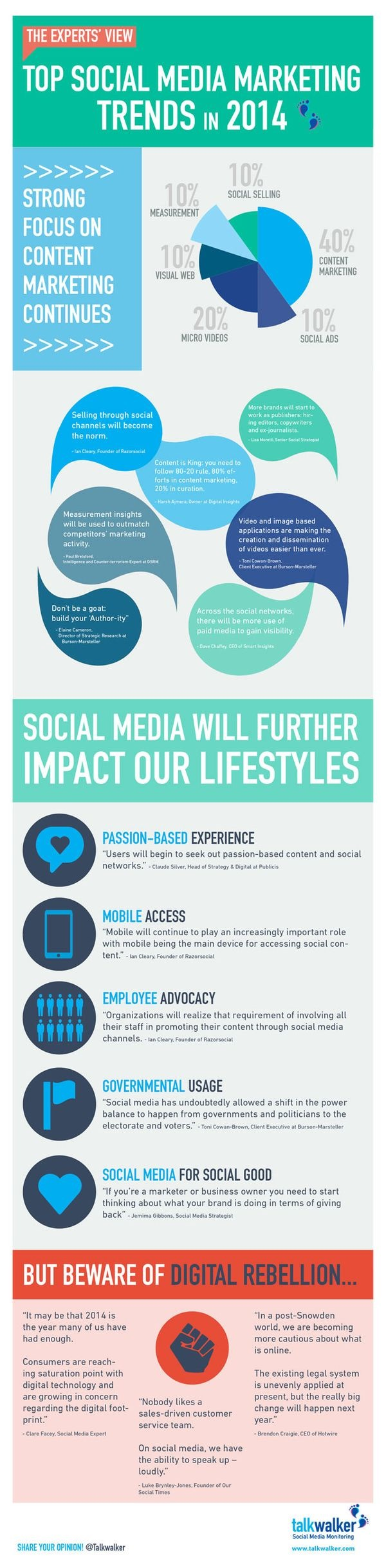
Infographic originally shared by @Talkwalker highlighting expert predictions for social media trends in 2014
A Strong Focus on Content Marketing
One of the most prominent themes in the infographic was the continued rise of content marketing.
Experts predicted that brands would focus heavily on producing content rather than simply pushing advertisements. Visual content in particular was expected to grow rapidly, including images, graphics, and short videos.
Looking back from today’s perspective, this prediction turned out to be remarkably accurate.
Over the past decade, content has become the foundation of most social media strategies. Platforms like Instagram, YouTube, and later TikTok built entire ecosystems around visual storytelling and short-form content. Even traditional platforms such as Facebook gradually shifted toward prioritizing engaging content over simple promotional posts.
In many ways, the shift toward content marketing that experts anticipated in 2014 became one of the defining characteristics of modern digital marketing.
The Growing Importance of Mobile Access
Another prediction highlighted the increasing role of mobile devices in accessing social media.
At that time, many users still interacted with social networks through desktop computers. However, experts believed mobile devices would soon become the primary way people consumed social content.
Today that prediction feels almost obvious. Most social media platforms are now designed with a mobile-first mindset. The majority of users access their favorite platforms through smartphones, and many features—such as vertical video formats—are built specifically for mobile usage.
This transition fundamentally changed how brands create content, forcing marketers to think about smaller screens, faster consumption, and shorter attention spans.
The Rise of Employee Advocacy
One interesting prediction in the infographic suggested that organizations would increasingly involve employees in sharing and promoting company content through their own social media networks.
At the time, this idea was still relatively new. But over the years, the concept evolved into what we now know as employee advocacy programs.
And It’s happen now, We witness many companies actively encourage employees to share insights, stories, and company updates through platforms like LinkedIn. In many cases, messages shared by employees feel more authentic than traditional corporate communication, which makes them particularly effective in building trust and credibility.
Social Media’s Influence on Society
Another observation from the experts was that social media could shift power dynamics between institutions and the public.
Platforms were beginning to give individuals a stronger voice in public conversations, allowing opinions, movements, and criticisms to spread rapidly.
Over the following decade, we witnessed just how influential social media could become in shaping public discourse. Social networks started playing significant roles in political discussions, social movements, and cultural conversations around the world.
In fact, if we look closely at how social media conversations evolved over the past decade, certain groups of users have played an outsized role in shaping online culture.
For example, women continue to dominate social media conversations, from the early blogging communities of the 2010s to the TikTok-driven creator economy today. I explored this evolution in more detail in How Women Continue to Dominate Social Media.
The Warning About “Digital Rebellion”
Perhaps the most interesting part of the infographic was a warning about something described as a potential “digital rebellion.”
Some experts suggested that users might eventually reach a point of digital saturation. With constant notifications, endless streams of content, and increasing marketing pressure, people could begin to feel overwhelmed by the digital environment.
Looking at today’s situation, that concern feels surprisingly relevant.
Many people now talk about digital detox, notification fatigue, and the need to disconnect from constant online activity. Discussions about privacy, algorithm transparency, and data usage have also become much more common.
While social media continues to grow, users are also becoming more aware of its impact on their time, attention, and mental well-being.
Quick Insights from Today’s Perspective
Looking back more than a decade later, it’s interesting to see how many of these predictions captured the direction of social media quite well.
Content marketing did not just continue, it became the backbone of modern digital marketing. Short-form video, visual storytelling, and creator-driven content now dominate many social platforms.
Mobile access also became the default way people interact with social media. In fact, many younger users today rarely use desktop devices for social platforms at all.
Employee advocacy also evolved into a common strategy, especially in professional networks like LinkedIn where individuals often represent the voice of their organizations.
At the same time, the warning about digital saturation feels more relevant than ever. Users are increasingly aware of how algorithms shape what they see, and conversations about privacy, attention, and mental health are now part of the broader discussion around social media.
In other words, the technology has evolved dramatically, but many of the underlying dynamics predicted back in 2014 were already beginning to take shape.
Why Old Trends Never Really Die
Old predictions like Social Media Trends in 2014 are useful reminders that marketing is always evolving.
Through many years, I saw how platforms will appear and fail. Algorithms will change. Content formats will rise and fall in popularity.
But the core challenge remains the same: understanding people, earning their attention, and creating messages that genuinely connect with them.
In the end, social media tools may change quickly, but the fundamentals of brand and marketing tend to move much more slowly.
And sometimes, looking back at old predictions helps us see those fundamentals a little more clearly